
The Currituck 4x4 area is the northernmost stretch of beach on the Outer Banks, running from the paved end of NC-12 in Corolla all the way to the Virginia state line at False Cape. There are no paved roads in this 11-mile area — the only way in is by driving on the beach. It’s home to the Corolla wild horses, Penny’s Hill, and the year-round communities of Swan Beach, North Swan Beach, and Carova. This page is your central guide to the entire 4x4 area.
Corolla · Swan Beach · Carova
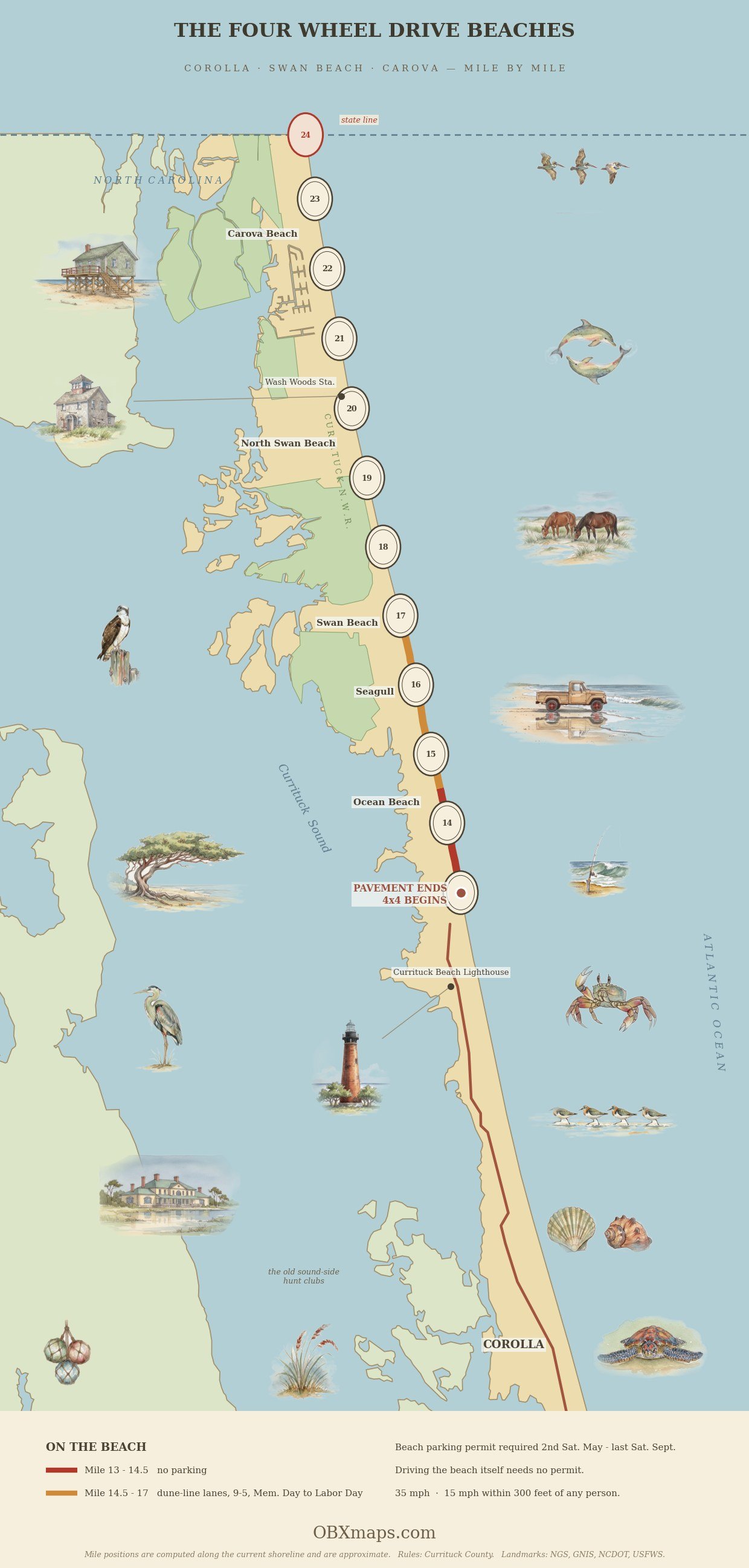
The 4x4 beach, mile by mile
North of the Corolla ramp the beach is the road for eleven miles. This map draws the county mile markers on the sand where they actually stand, from the ramp at mile 13 to the Virginia line at 23.9.
Quick Facts
| Length | Approximately 11 miles of beach (NC-12 end to VA line) |
| Access Point | End of NC-12 in Corolla (paved road ends at beach) |
| Vehicle Required | True 4x4 with low range — AWD not recommended |
| Permit Required | No — Currituck County does not require a beach permit |
| Tire Pressure | 18–20 PSI on sand, re-inflate to 38 psi on pavement |
| Speed Limit | 15 MPH on beach, 25 MPH on sand streets |
| Communities | Swan Beach, North Swan Beach, Carova |
Location & Aerial View

Open in Google Maps for driving directions →
How to Access the Currituck 4x4 Area
From Corolla, drive NC-12 north past the Currituck Beach Lighthouse and the Whalehead Club. The road continues for several miles past the Outer Banks Center for Wildlife Education, then ends at a public beach ramp. There’s typically law enforcement at the ramp checking that vehicles are 4x4. Air down your tires to 18–20 PSI in the paved staging area before driving onto the sand. Don’t have a true 4x4? You can rent one locally from Beach4x4.
What’s in the 4x4 Area
Moving from south to north: the staging area and Outer Banks Center for Wildlife Education are right at the pavement end. About 2 miles north is Swan Beach. Around 3 miles north is Penny’s Hill, the highest natural point between Corolla and the Virginia line. North Swan Beach runs 4–6 miles up. Carova proper starts around mile 6–7 and continues to the Virginia border at False Cape State Park, where access ends at a fence.
The Wild Horses
The 4x4 area is the protected home of about 100 Colonial Spanish mustangs — direct descendants of horses brought to the Outer Banks by Spanish explorers in the 1500s. They roam freely between the dunes, maritime forest, and yards. Currituck County law requires staying at least 50 feet from any horse; getting closer or feeding them is a misdemeanor under the county code. Never honk, chase, or attempt to touch them.
What to Bring
Plan as if you’re driving into the wilderness — because you basically are. There are no gas stations, restaurants, stores, or services anywhere in the 4x4 area. Bring drinking water, snacks, a full tank of fuel, a tire gauge, a portable air compressor or CO2 inflator, a tow strap, and a shovel. Cell service is unreliable. Download offline maps before going in.
Tides Matter
Beach driving in the Currituck 4x4 area is dramatically easier at low tide, when firm wet sand near the waterline gives traction and predictable steering. At high tide, drivers are forced onto soft dry sand against the dunes, which is where most people get stuck. Check the tide chart for Oregon Inlet or Duck and plan to enter and exit the 4x4 area within 2 hours of low tide whenever possible.
Frequently Asked Questions
Do I need a permit to drive in the Currituck 4x4 area?
No. Unlike Cape Hatteras National Seashore, the Currituck County 4x4 area needs no NPS ORV permit — but a Currituck County beach parking permit is required to stop or park on the 4WD beach during the season. You just need a true 4x4 vehicle, properly aired-down tires, and common sense.
Where does the Currituck 4x4 area begin and end?
It begins at the end of paved NC-12 in north Corolla and ends at the Virginia state line at False Cape, about 11 miles north. False Cape State Park (Virginia) does not allow public beach driving, so the fence at the state line is the northern boundary.
Can I camp in the Currituck 4x4 area?
No. Camping is not permitted anywhere on the beach in the 4x4 area. The communities of Swan Beach, North Swan Beach, and Carova are private vacation rental areas. Visitors stay in rental homes.
Are there bathrooms in the 4x4 area?
No public restrooms. Use facilities in Corolla before driving in. Most vacation rentals have full bathrooms for guests.
What if I get stuck?
First, don’t panic and don’t keep spinning your tires — that just digs you deeper. Air down to 18-20 PSI first; if you’re stuck, drop a few PSI temporarily and re-inflate once you’re free. Clear sand from in front of tires, and try to back out in your own tracks. If you can’t self-recover, call a local 4x4 towing service (Outer Banks Beach Rescue, Carova Beach Rescue Co.). Tows in the 4x4 area are not cheap, so carry recovery gear and know how to use it.
Are AWD crossovers allowed?
Technically they are not prohibited, but they are strongly discouraged. AWD systems on most crossovers lack low-range gearing and are not built for sustained sand driving. Deputies at the ramp may turn you back, and you are very likely to get stuck even at low tide. If yours is a crossover, Beach 4x4 rents true 4x4s with both beach permits included.